






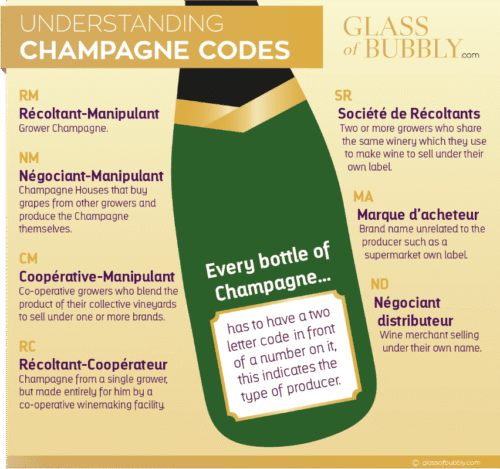
John Dvorak is enlightening us about Champagne. If it’s a real Champagne, produced in France, it contains a small letter code which informs you if the producer grew their own grapes or sourced them from grower. Dvorak also recommends the ‘NM’ Champagnes as they are ‘Growers Champagne.’ and produced their Champagne with grapes they grew themselves.
Here’s a handy chart!
Champagne codes are abbreviations found on labels that indicate the type of producer. Common codes include NM (Négociant Manipulant), which refers to a merchant who buys grapes and makes wine, and RM (Récoltant Manipulant), which indicates a grower who produces champagne from their own grapes.
Understanding Champagne Codes
Champagne labels often include specific codes that indicate the type of producer and the quality of the wine. Here are the main codes you might encounter:
Producer Codes
| CODE | MEANING |
|---|---|
| NM | Négociant Manipulant: A producer that buys grapes and makes wine, typically larger brands. |
| RM | Récoltant Manipulant: A grower who produces champagne from their own grapes. |
| RC | Récoltant Coopérateur: A grower who sells wine made by a cooperative. |
| CM | Coopérative de Manipulation: A cooperative that produces wine from member growers. |
| ND | Négociant Distributeur: A distributor that markets champagne under its own brand. |
| MA | Marque Auxiliaire: A buyer’s mark, indicating a label affixed by a retailer or distributor. |
| SR | Société de Récoltants: A group of producers working together to market their products. |
Importance of Codes
These codes help consumers understand the origin and production methods of the champagne. For example, RM champagnes often reflect the unique characteristics of the vineyard, while NM champagnes may offer a broader range of styles due to sourcing grapes from various locations.
Additional Label Information
In addition to the producer codes, champagne labels typically include:
- The word “Champagne” to confirm its origin.
- The producer’s name and location.
- The style of champagne (e.g., Brut, Demi-Sec).
- The vintage year, if applicable.
- Alcohol content and bottle size.
Understanding these elements can enhance your champagne selection experience and ensure you choose a bottle that meets your preferences.
[No Agenda #1822]