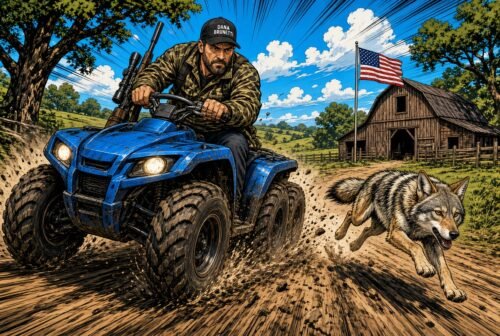







On Scanning Podcast #3, Dana Brunetti described his go-to setup for coyote and squirrel control on his property: a pair of big-bore, 30-caliber pre-charged pneumatic (PCP) air rifles from Utah Airguns, running him roughly $4,000 each. They’re built with a built-in moderator that brings the report down to about as loud as a .22 — not a true suppressor, Dana was careful to note, but similar in effect — and he says the accuracy beats his AR-15. They’re rated for coyote and large-squirrel-sized game; he was clear it would do serious damage to a person too, so this isn’t a toy.
What makes this worth a second look is the legal wrinkle Brunetti and Dew got into on the air — one most people, including most gun owners, have never heard explained. California bans actual firearm suppressors outright and heavily restricts automatic weapons. But under the state’s Penal Code (§16520), a “firearm” is specifically defined as a device that expels a projectile by the force of an explosion or combustion. A compressed-air gun doesn’t combust anything, so legally it isn’t a firearm at all — which means the suppressor ban, the NFA paperwork, and the entire regulatory framework around moderators and select-fire mechanisms simply doesn’t apply to it, even on a big-bore rifle powerful enough to take down a coyote.
One caveat on that: it’s a general reading of state-level firearm definitions, not a blanket pass everywhere. Some other states and localities still apply their own rules to air-powered weapons specifically (sale-to-minors restrictions, school-zone rules, and so on even apply in California), and discharge ordinances vary a lot by city and county — some municipalities name “air guns” directly in their noise/discharge codes even though the state doesn’t treat them as firearms. Worth checking your local rules before you fire one off, especially anywhere more built-up than a ranch.
Separately, the same episode had another legal detail worth passing along: Brunetti also carries a standard concealed-carry permit (CCW), issued by his home county — a more rural, conservative part of California — and under state Penal Code §26220, a CCW issued by any county sheriff is valid for carrying statewide. That means his county-issued permit lets him legally carry in Los Angeles, a famously strict, deep-blue jurisdiction that has historically made it much harder for its own residents to get approved. It’s not a loophole so much as how California permits have always worked — where you live decides how easy it is to get one, but once issued, it travels with you statewide — though it’s a wrinkle most people, including a lot of CCW holders, have never had explained to them. Worth noting the 2022 Bruen Supreme Court decision forced California to drop the discretion that let sheriffs in places like LA County turn away most applicants, so that old gap between easy rural counties and hard urban ones has narrowed since — but the statewide-validity piece hasn’t changed.
Utah Airguns carries the big-bore PCP line Dana’s describing (AirForce Texan and Tex-Rex, AEA, and similar), if you want to see what’s out there.
[Scanning Podcast #3 84:12]